How Much Do Air Purifier Filters Cost in Canada? (2026 Guide)
A Canadian guide to replacement filter cost tiers, compatibility mistakes, and long-term ownership value.
Air purifier filters are where many Canadian buyers feel the real cost of ownership. The purifier is a one-time purchase, but filters come back every season, every year, or sooner if you run the unit during wildfire smoke, allergy season, pet shedding, winter cooking, or dusty renovation periods.
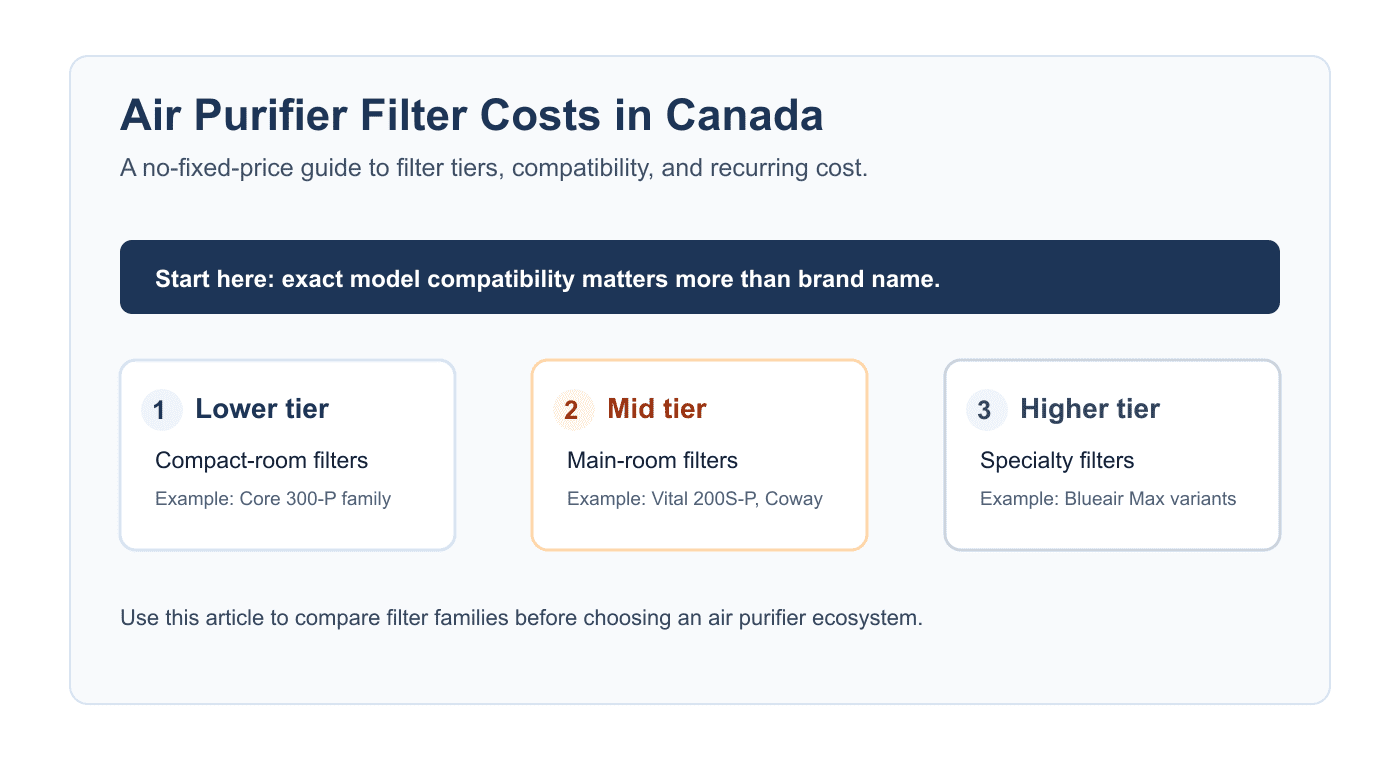
This guide does not list fixed prices because Amazon.ca, Canadian retailers, coupons, bundles, and third-party sellers change constantly. Instead, it compares relative cost tiers, replacement cadence, compatibility risks, and filter types so you can make a better buying decision before you commit to a purifier.
Methodology: this guide is based on public manufacturer documentation, Canadian retailer listings, Amazon.ca search availability, and compatibility notes from official sources. We do not claim hands-on testing of these replacement filters.
Quick Answer: Which Filters Cost More Over Time?
| Filter Family | Relative Tier | What to Watch | Filter Link |
|---|---|---|---|
| LEVOIT Core 300-P | Lower tier | Many variants; match Core 300-P/Core 300S-P exactly. | View Filters |
| LEVOIT Vital 200S-P | Mid tier | Larger filter; smoke/toxin variants can change ownership cost. | View Filters |
| Coway AP-1512HH | Mid tier | Serial-code compatibility matters; AP-1512HHS uses a different filter. | View Filters |
| Blueair 311i Max | Higher tier | Proprietary filter options; confirm 311i Max vs 311i+ Max. | View Filters |
Replacement Filter Comparison
| Product | Cost Tier | Cadence Signal | Compatibility Notes | Filter Link |
|---|---|---|---|---|
| LEVOIT Core 300-P | Lower tier | 6-8 months per Levoit guidance | Original, Smoke Remover, Pet Allergy/Toxin variants. Confirm Core 300-P/Core 300S-P compatibility. | View Filters |
| LEVOIT Vital 200S-P | Mid tier | Check filter indicator and usage | Larger filter; Smoke Remover/Toxin variants use model codes such as LRF-V201-BUS or LRF-V201-GUS. | View Filters |
| Coway AP-1512HH | Mid tier | Filter set compatibility depends on serial-code family | Coway warns AP-1512HH/AP-1512HH(W) and AP-1512HHS use different filters. | View Filters |
| Blueair 311i Max | Higher tier | Up to 9 months depending on usage, per Blueair | Particle + Carbon, AllergenBlock and SmokeBlock options. Confirm 311i Max vs 311i+ Max. | View Filters |
| Winix 5500-2 | Mid tier | Yearly set per Winix Filter H guidance | Filter H / 116130 is the key compatibility term. Home Depot Canada also lists this model. | View Filters |
| Honeywell HPA300 | Higher total annual filter count | Annual HEPA replacement guidance from Home Depot listing | HPA300 uses multiple R filters; confirm HPA300/HPA300C compatibility before buying. | View Filters |
How to Choose the Right Replacement Filter
1. Match the exact model first
Do not buy only by brand name. LEVOIT, Coway, Blueair, Honeywell, and Winix all have filter families that look similar but fit different machines. Coway specifically warns that AP-1512HH/AP-1512HH(W) and AP-1512HHS use different filters.
2. Decide between standard, smoke, pet, and toxin variants
LEVOIT and Blueair both sell specialized filter variants. A smoke-focused filter can make sense during wildfire season, while pet/allergen variants may be more relevant year-round. The right choice depends on the air problem you are solving, not just the purifier model.
3. Check replacement cadence
LEVOIT lists 6-8 months for Core 300-P filters. Blueair says 311i Max filters may last up to 9 months depending on use. Winix describes Filter H as a one-year replacement set. Treat these as starting points, not guarantees, because Canadian wildfire smoke, pets, cooking, and daily runtime change real filter life.
4. Be careful with marketplace-compatible filters
Compatible filters can be cheaper, but they are not all equal. Check recent reviews for fit problems, odour complaints, loose seals, missing carbon layers, and unclear model compatibility. For a purifier you bought for smoke season, genuine filters are usually the safer first comparison point.
Best Filter Strategy by Canadian Situation
- Wildfire season: compare smoke-focused variants first, especially for LEVOIT Core 300-P, LEVOIT Vital 200S-P, and Blueair Max filters.
- Pets: consider pet/allergen variants, but confirm they match your exact purifier model.
- Winter sealed homes: if cooking odours and PM2.5 are the issue, carbon matters more than many shoppers expect.
- Budget ownership: prioritize models with widely available replacement filters on Amazon.ca and major Canadian retailers.
- Older purifiers: confirm the model is still supported before buying another machine in that ecosystem.
Mistakes to Avoid
- Buying by photo: filters can look similar but use different dimensions or tabs.
- Ignoring model suffixes: Core 300, Core 300-P, Core 300S-P, AP-1512HH, and AP-1512HHS are not interchangeable by assumption.
- Assuming washable means permanent: washable pre-filters are not the same thing as washable HEPA-style filters.
- Waiting until wildfire smoke arrives: popular filters can become harder to find when demand spikes.
- Only checking one retailer: compare Amazon.ca, brand stores, Home Depot Canada, Walmart Canada, Best Buy Canada, and Canadian Tire where relevant.
Related SmartMarketPicks Guides
FAQ
How often should I replace an air purifier filter?
Follow the manufacturer guidance for your exact model. Many filters are replaced every 6-12 months, but heavy wildfire smoke, pets, cooking particles, dust, and long daily runtime can shorten real-world life.
Should I buy genuine or compatible filters?
Genuine filters are the safer first choice when performance, warranty, and filter-life sensors matter. Compatible filters can cost less, but shoppers should check fit, seller reputation, return policy, and recent buyer complaints.
Which filter type should I choose for wildfire smoke?
Look for particle filtration plus enough activated carbon for smoke odours and gases. For LEVOIT and Blueair models, smoke-focused variants may be worth comparing during wildfire season.
Can I wash a HEPA filter?
Do not wash a HEPA filter unless the manufacturer explicitly says it is washable. Many washable parts are pre-filters, not the main HEPA-style filter.
Why are some replacement filters expensive?
Larger filters, specialty carbon blends, proprietary shapes, subscription models, and bundled HEPA/carbon sets can raise operating cost. That is why compatibility and replacement cadence matter before buying the purifier.
Final Verdict
If you want the lowest long-term stress, buy an air purifier only after checking the exact replacement filter family. For most Canadian shoppers, the best filter ecosystem is not simply the cheapest one. It is the one with clear compatibility, easy Canadian availability, sensible replacement cadence, and the right filter variant for your actual problem.
For current owners, start by searching your exact purifier model plus the word “replacement filter.” For new buyers, check filter availability before buying the purifier itself.
Popular filter searches:
Sources Consulted
- LEVOIT Core 300 Series Original Filter
- LEVOIT Core 300-P Smoke Remover Filter
- LEVOIT Vital 200S-P Smoke Remover Filter
- Coway AP-1512HH filter replacement guidance
- Blueair 311i Max Particle + Carbon Filter
- Winix Filter H 116130
- Home Depot Canada Honeywell replacement filter listing
Affiliate Disclosure: This guide contains affiliate links. We may earn a commission at no extra cost to you if you make a purchase through our links. This helps us continue providing comprehensive Canadian product reviews.